
Hamar quickly wrestled himself backwards all the way through the hole and took great lungfuls of air. He couldn’t get deeper, caught there in a knot of thorns.
The scrape on his head burned and he wriggled a hand free to dab and dab at the blood on it. Thorns cut him everywhere.
As minutes passed his heart slowed, his panting slowed. Finally he breathed easier and found his wits again. In a little while he smiled.
This was, after all, just another day.
A few minutes later he carefully untangled some branches and eased himself up. The men’s voices on the other side of the wall were fading off into other streets, taken up with arguing about their broken goods.
They wouldn’t be coming back now, their own stalls too precious to leave for long. Now, he really was safe.
But where was he though?
He spat on his fingers and ran them along the sticky scratches on his face and arms, and then he checked the knot of vines to see if he’d stumbled into a wild dog’s nest. But no, only rat tunnels wound low through the under-brush.
This place was shady, the fierce sunlight almost shut out by the dark of mounded brambles and high thorn bushes. He looked for the sides to the place and saw it seemed to be a square.
No balconies or windows overlooked the square though, only the blank backs of some huts and storehouses that made it up. He turned to make certain no last attacker was coming behind him through the fissure, but then he reasoned that they’d all been too big for it anyway.
Besides, none of them knew he was in there.
There was no recent rubbish in the place, no old hill of broken amphori or broken pots or dumped crates on top of the scrub, no tumbled-down huts. Apparently this small no-man’s-land was long abandoned as of no use to anyone. He could relax, then, the morning’s chase really was over.
But what exactly was this square? He strained to see to every corner. Step by step he carefully began untangling a path through the brambles.
He had just forced apart two especially big tangles when there on the ground underneath him were some old charred paving stones. Hamar stopped short!
Whenever new diggings hit burnt rocks people in Al Musar pulled up their shovels, fast, and cursed the remains as they buried them again, buried them deep.
Everyone in Al Musar knew the town was founded on the caves and altar belonging to an unknown people who hadn’t sacrificed goats and calves, – but humans! It was an age-old legend every generation learned, a famous Al Musar tale shared with all newcomers over the town’s weak beer. It told of eerie powers and deadly Musari words and spells, of how the original inhabitants had occupied this high ground to kill people when they’d worshipped, as had pleased their gods.
The ancient legend told of a conqueror with a lion-head helmet who’d arrived to impale the priests alive on big stakes and who’d destroyed their blood-tarred altar, before filling in the cave entrances with boulders and burning the temple housing, even torching its stones. All children, even foreign outcasts like Hamar, knew of Al Musar’s evil past.
But in truth Al Musar’s history had more in it than was known in their legend. The town began after the massacre and destruction were long over, – decades after the charred wood and limestone ruins had drained away in winter rains and nothing was left there but tumbled-down rocks on the hillside. Passing flocks had nosed out the trickle from the filled-in well, and finally farmers had considered the abandoned grazing slopes too tempting, so they’d ended up trying out chants to nicer gods who’d let them dig out the well and plough the ground unharmed.
People had passed those chants on, and belief in their new local gods had replaced their fear of ancient, unknown, – bloodthirsty – ones.
Life had gone on gently for centuries. Farming families had settled there and established their barley fields and cow-paths and when enough grown children had married even more people and put up new mud houses, the paths between had become streets, and with outsiders moving in to do trade the important folks built big houses, and, later, halls, until the place became known as a town.
After many dozens of generations it had filled the wall boundary and had spread out to another wall, then another one, and Al Musar was now counted as a fortified city on a hill, a high white landmark to caravans needing to stop. It covered more than seven acres, and any evil remains were interred out of sight many levels down.
Not a lot of detail was known about those killers and their mysteries any more, but the legends had grown bigger with ideas about bloody rituals, complete with images of weird distorted beings, so that people sitting in quiet rooms froze when they thought they heard chants going on, thought they saw black djinns flitting across rooftops on moonlit nights, – a few streets were named for the putrid smells mysteriously drifting up sometimes from bottomless cracks in the ground, and there were certain dark alleyways not even beggars ever used for shortcuts.
Al Musar had a big temple to the god Marduk in its center where worshippers could present offerings for protection from evil beings and from curses and for fertility and health and prosperity. A lot of the homes had traditional hex symbols on the walls, which blessedly seemed to work. But all it took was someone uncovering a few burnt stones to set off a wave of fear that made farmers blame stillborn lambs and fevers on the discovery, and the towns-folk sacrifice bigger animals in the temple, buy amulets.
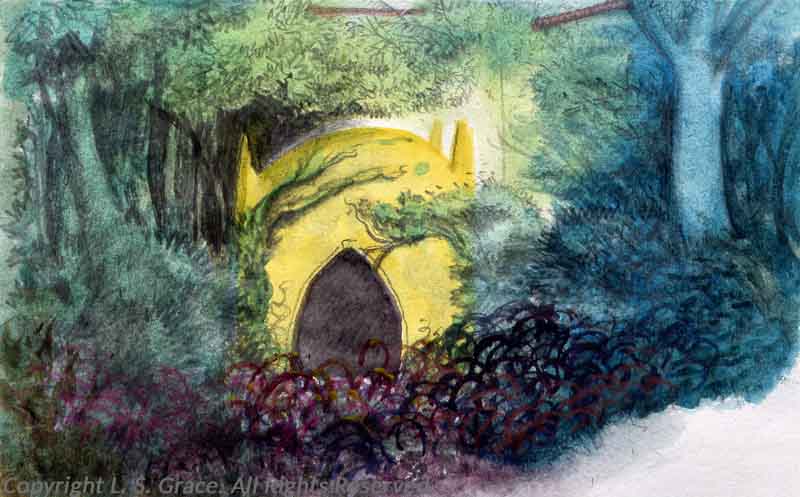
Hamar peered around the undergrowth. Clearly, no one in Al Musar knew of this place; it had no name, wasn’t talked of. With a start he saw that something in the garden wasn’t bushes.
Something big!
Leave a Reply